

Luiza Aikawa
On Sunday, October 4, 2026, the Brazilian population went to the polls to vote in the general elections for state and federal deputies, governors, senators, and the president. The vast majority of the contested seats had their results published by the end of the same day, with the exception of the few gubernatorial races that, like the presidential dispute, went to a runoff. Early analyses published on the topic spoke of a sweeping victory for the right, which is true, but it does not reflect a new phenomenon and contains important nuances that merit analysis. The result reflects, overall, a continuity of the hegemony that the right-wing camp has established over the left and the center since 2018, and which shows no signs of slowing down.
In the Chamber of Deputies, the advance of the right was smaller than in the Senate, where its growth has been steep since the year that marked Jair Bolsonaro’s election. The movement in the state executive branches is more clearly a victory of the right over all others, this being the main arena where the left has effectively lost ground. These results are particularly concerning in a context marked by electoral campaigns for Governor and Senator based on, among other themes, antidemocratic promises to impeach justices of the Supreme Federal Court (STF). The victorious right does not merely represent a camp with more liberal economic values, but an increasingly conservative movement that publicly flirts with authoritarianism.
The graphs below illustrate the trend I describe from a longitudinal perspective, starting in 2002. The Senate analysis considers each newly formed legislature by combining the portion of members elected in each cycle with the portion that remained in office. For the gubernatorial results, the 7 states whose final decision was deferred to the runoff on October 25, 2026, are excluded. Of these, 5 concluded the first round with right-wing candidates receiving more than 45% of the valid votes, strongly indicating that the scenario tends to consolidate exactly as described here.
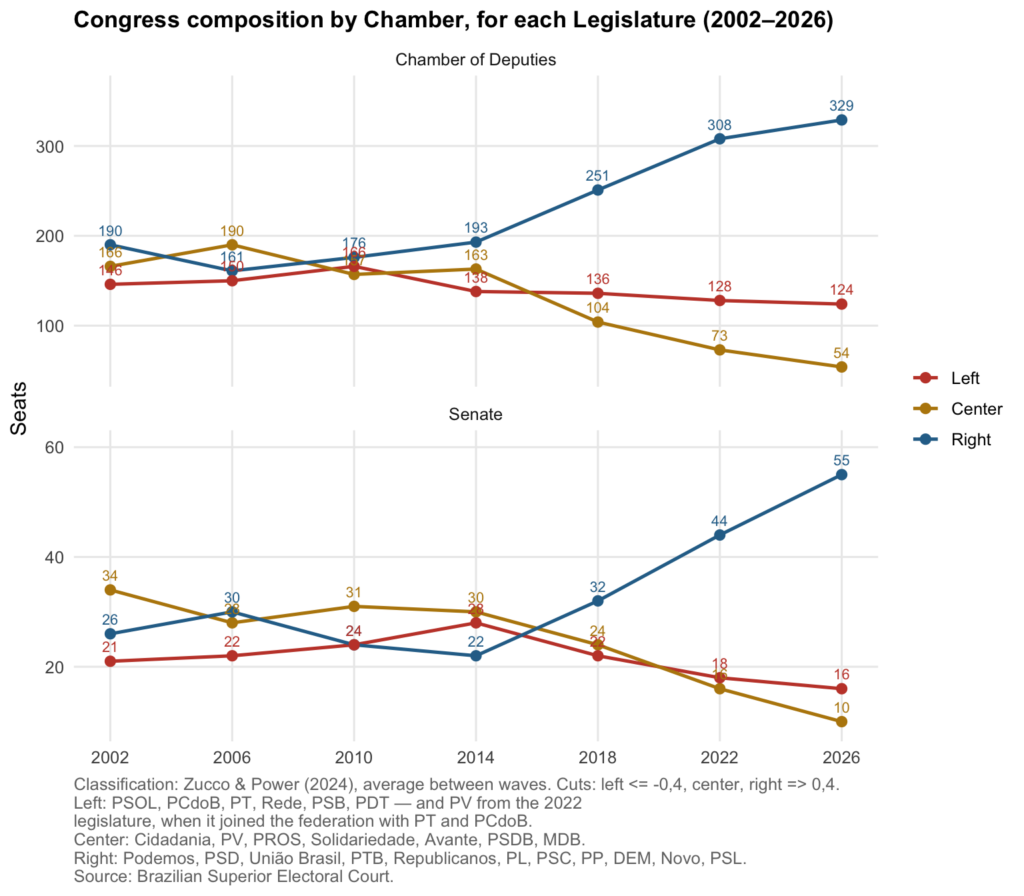
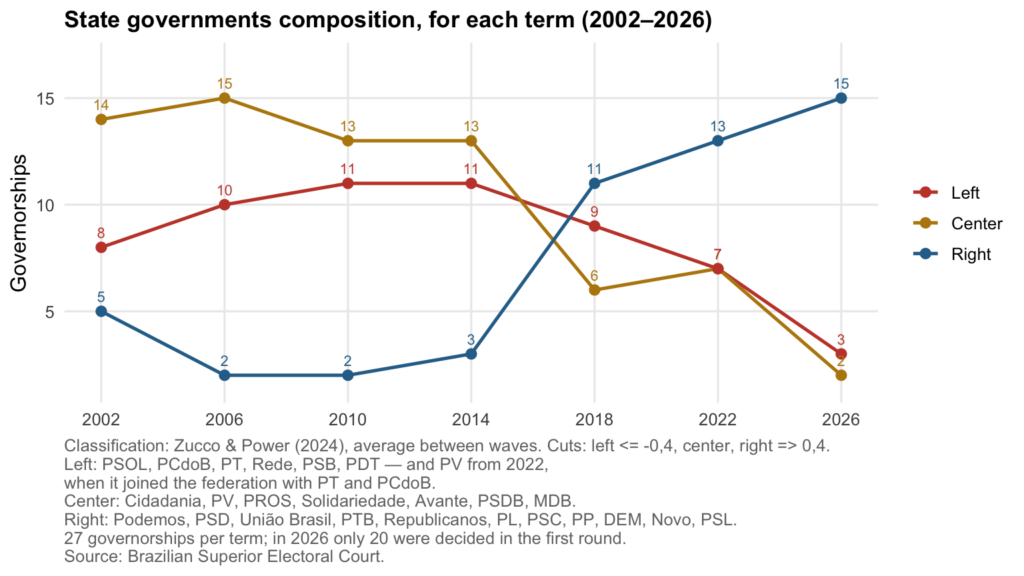
This growth of the right over the last two general elections highlights a polarizing trend, in the sense that it depletes center parties much more than those on the left. If previously the Brazilian electorate directed its vote toward center lists in proportional disputes, and especially in state-level Executive races, it now seems eager to subscribe to the platforms offered by the more conservative and firmly right-wing parties. It is crucial to reflect on what this rise in majoritarian election offices specifically means.
The literature on Executive-Legislative relations features a classic argument regarding the impact of electoral rules on the ideological composition of elected offices. This argument has been debated and revised over the last three decades, often citing Brazil as a typical case study. The theoretical premise is roughly as follows: to win majoritarian disputes, a candidate needs an absolute majority of votes in the state (for governors) or the largest plurality of votes (for senators). This theoretically compels campaigns to focus on large urban masses and adopt redistributive or universal development proposals, which typically lean toward progressivism and appeal better to such urban electorates.
Conversely, the Chamber of Deputies, elected via proportional representation, has a more fragmented electorate across the states. Due to the Chamber’s seat distribution rules, rural, agrarian, and less populated states (where traditional and conservative elites would theoretically exercise more control over the vote) end up being overrepresented. In contrast, the mechanical underrepresentation of large urban and industrial centers supposedly shifts the parliament’s center of gravity more strongly toward conservatism.
Much of the revisionism in this literature has focused on how these effects are not deterministic regarding the legislative process, noting that the Executive possesses important tools to negotiate common ground on the political agenda. However, this is not the point I wish to highlight. Rather, I want to emphasize how conservative agendas have gained such traction with the Brazilian electorate that their success is no longer limited to offices where electoral rules inherently favor minority positions. On the contrary, they have gained ground over the left compared to the last election even in spaces where pluralist mechanics favor the majority’s opinion. Today, the arena where the left loses the least, the Chamber of Deputies, is precisely the one that allows for a greater diversity of positions as a structural result of proportional representation.
This victorious right wing is even reducing its internal fragmentation, despite the first round of the presidential race featuring four candidates from this ideological camp competing for the position of the “electorally viable third-place candidate”: Augusto Cury (Avante), Renan Santos (Missão), Ronaldo Caiado (PSD), and Zema (Novo). By analyzing the parties within this spectrum, it becomes evident that electoral strength is consolidating into a central party, the PL (Liberal Party), carrying significant consequences for party fragmentation in the National Congress.
Both houses of the National Congress have reached historically low levels of party fragmentation, measured both by the raw number of represented parties and the Effective Number of Parties (ENP). Part of this stems from electoral reforms implemented with the explicit intention of “moralizing” a party system that had been hyper-fragmenting since 2002. These reforms introduced rules that raised the barriers to securing seats in proportional elections and restricted access to vital organizational resources for parties with few elected officials. Parties failing to meet the electoral threshold are excluded from the distribution of nearly US$ 1 billion in public funds (the Party Fund) and are barred from broadcasting free political advertising on television and radio.
Another factor, however, is the remarkable ability of the PL — the party of former President Jair Bolsonaro and current presidential candidate (and his son) Flávio Bolsonaro — to capture political space even at the expense of other right-wing parties, such as União Brasil, PP, and PSDB, particularly in the Chamber of Deputies. The graph below illustrates how the Chamber has reached the lowest number of represented parties since 2002, the year of Lula’s first election. The House’s ENP is the second lowest since 1998, when it reached 7.1 effective parties. In the Senate, the ENP dropped to the same value as in 2002, with a slightly higher total number of represented parties, equivalent to the 2006 election. This is largely driven by the PL’s bloc pulling the indicator downwards after having achieved the largest since Brazil’s redemocratization, comprising 28 senators.
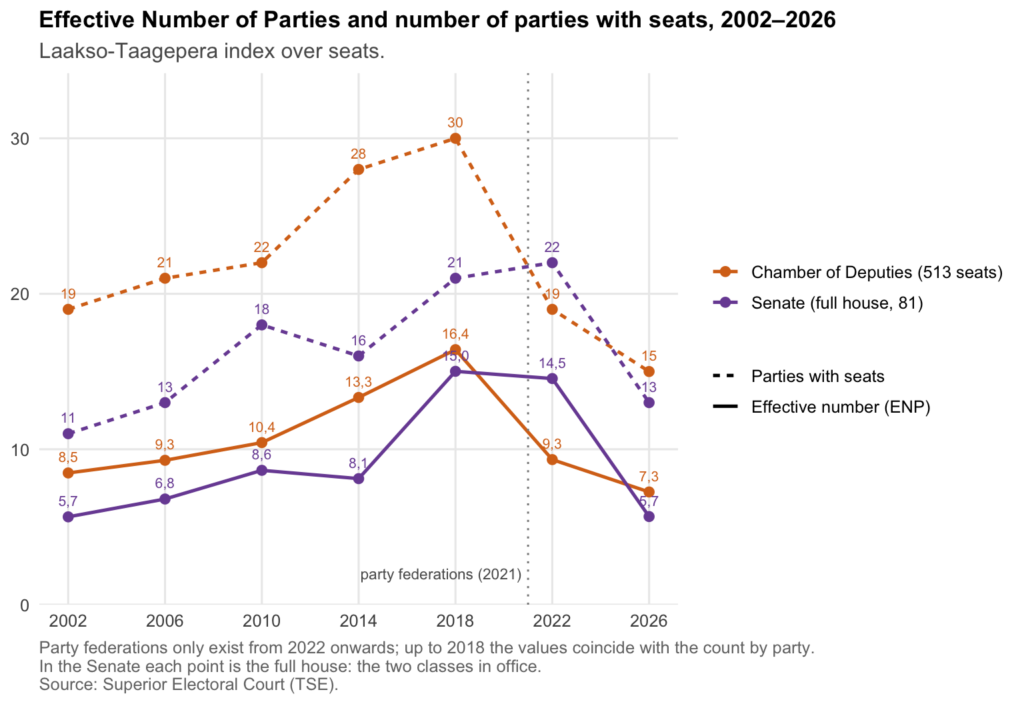
Effectively, the PL was the grand victor of this election cycle. The party secured the largest legislative bloc in the Chamber of Deputies since 1994, winning a total of 121 seats, 23 more than in the previous legislature. In the prior election, the PL had already formed the largest bloc, albeit in a more fragmented Chamber. This means that a single party will hold nearly half of the 257 votes required to pass standard legislation on the floor, and approximately 40% of the 308 votes needed for a constitutional amendment. In the context of Brazilian coalition presidentialism, this concentration of power is far from trivial.
In the Senate, the scenario is even more drastic. The PL captured 13 more seats than it did in 2018, the last time the upper house renewed two-thirds of its seats. Beyond having implications similar to those in the Chamber regarding the party’s leverage in political negotiations, this election sent clear signals about the electoral coordination capacity of different political camps. When two out of three seats per state are up for election, running a strong campaign and mobilizing the base is not enough. Each voter has the right to cast two votes, and effectively directing that second vote is a critical part of the civic education process in which parties play a vital role. The left failed in this strategic process, losing out on all contested seats in 19 of the 27 states.
A critical implication of the first round is what this landscape means for the two presidential candidates heading into the runoff. Flávio Bolsonaro secured 47% of the valid votes, while Lula received 45.2%. Compared to opinion polls from the week prior to the election, Flávio surged at the expense of other right-wing candidates, demonstrating a clear pattern of strategic voting (voto útil) within that camp. Given the narrowest margin between the top two candidates in the first round since Brazil’s return to democracy, I will not venture to predict voter behavior in the second round. However, it is noteworthy that Lula built his 2026 campaign with an electoral coalition comprising 3 fewer parties than in 2022 (10 now, compared to 13 then). Meanwhile, Flávio, despite frequently positioning himself as a more moderate version of his father, did not exhibit a conciliatory approach when forming his coalition. This year, he opted to run on a single-party ticket (chapa pura), contrasting sharply with the already reduced 3-party ticket his father led in 2022.
In Brazil, electoral coalitions do not strictly predetermine governing coalitions, and either candidate will be forced to negotiate support across multiple parties to advance their legislative agendas. Yet, this process will be significantly easier for Flávio Bolsonaro. If victorious, his own party’s bloc will carry a weight practically equivalent to that of all left-wing parties combined. He enjoys a much higher baseline of legislative support, substantially reducing the number of external parties he would need to appease to form a governing coalition.
This scenario represents something of a plot twist, considering that early in the campaign, the candidate struggled to secure a running mate to join his ticket. All evidence suggests that Flávio attempted to forge a coalition between the PL and other right-wing parties but failed to reach an agreement before the formal candidacy registration deadline. Pushed to the legal limit, he settled for a single-party ticket, selecting a vice-presidential running mate from his own party (affiliated since 2026) who had only participated in her first electoral contest in 2020. This does not appear, therefore, to be a deliberate strategy anticipating such overwhelming electoral success that alliances could simply be rejected.
For Lula, the outlook for a potential government is considerably more daunting. With the left securing only 124 seats across all its parties, not even a hypothetical coalition with the victorious center parties (54 seats) would be sufficient to pass legislation in the Chamber of Deputies. Should he manage to overcome his first-round deficit, he will face the arduous task of negotiating concessions with a highly hostile Congress. By all indications, this would mirror the struggles of his current, concluding term, but with significantly more robust institutional hurdles.
It remains to be seen, when the new legislature convenes in February, what partisan realignments may occur among members of parliament, and which parties will benefit. Close attention should be paid to the 34 federal deputies elected by parties or federations that failed to meet the electoral threshold, as their operational viability outside of elections is severely threatened. It is highly unlikely, however, that there will be enough defections to offset the PL’s massive electoral victory. From a systemic perspective, all indicators point to declining party fragmentation, which will likely strengthen the largest factions as they absorb the remnants of parties unable to survive the new institutional reality.