

Joris Alberdingk Thijm
How do coalition governments in presidential systems manage delegation and ensure that collectively agreed policies get implemented? The president is constitutionally the principal of cabinet ministers, but not of those ministers’ parties, even when the parties belong to the coalition. Coalition parties negotiate cabinet posts and policy influence in exchange for legislative support (Amorim Neto, 2006; Ames, 2001; Raile, Pereira, and Power, 2011; Magar & Moraes, 2012), and so have a stake in ensuring agreed-upon policies are enacted, even absent a formal contract (Samuels & Shugart, 2010, p. 227).
In two recent papers (Alberdingk Thijm, 2024a; Thijm & Fernandes, 2025), I examine one monitoring strategy parties use: shadowing. Adapting the concept from the parliamentary literature to a multiparty presidential context, I define shadowing as a difference in partisan identity between a minister and the corresponding junior minister (JM) or committee chair (CC) (Thies, 2001; Kim & Loewenberg, 2005). JMs and CCs act as “fire alarms” (McCubbins & Schwartz, 1984), warning their parties if a minister steers policy off course.
Using an original dataset covering 25 (31) cabinets with JMs (CCs) across three conti-nents, I find that CC shadowing depends on the degree of agency loss a party can expect from a given minister, measured via ideological distance (the risk of loss) and portfolio salience (its potential cost). Powerful committee systems reduce the probability of shadowing, per-haps because cross-branch, intraparty agency loss becomes too costly once legislators control such institutions and could undercut their own party’s executive wing (see also Samuels and Shugart, 2010). No such effect appears for JM shadowing, which instead increases with presidential powers (higher cost of agency loss to the president) and democratic experience, suggesting institutional learning.
Coalition governance in presidential systems
Ministers in coalition governments face incentives to pull policy towards their (parties’) ideal points and away from the coalition’s collective ideal point (Thies, 2001). Coalition partners can avoid this by devising ways to detect signs of such ‘shirking’ before it causes any damage. We know from the parliamentary literature that JMs and CCs can serve as ‘fire alarms’ that discourage shirking due to their privileged access to information and their connection to the party (Thies, 2001; Kim & Loewenberg, 2005; Lipsmeyer & Pierce, 2011; Carroll & Cox, 2012). The strategy is to negotiate JM and CC posts overseeing ministries held by other parties in order to keep tabs on them (ibid.).
Presidential coalitions differ from parliamentary ones. Notably, the president heads the cabinet and can hire and fire ministers without risking her own survival in office (Amorim Neto & Samuels, 2010), yet presidents in fragmented party systems still depend on other parties to govern (Cheibub et al., 2004), trading cabinet posts, pork, and policy influence for legislative support (Amorim Neto, 2006; Ames, 2001; Raile, Pereira, and Power, 2011; Magar & Moraes, 2012). Even though presidential coalitions are less horizontal than parliamentary ones, junior partners retain a stake and some leverage over outcomes (Magar & Moraes, 2012).
The mechanics of shadowing
JMs have privileged access to what happens inside “their” ministries, making them well-suited fire alarms (Thies, 2001). They can be partisan or independent; independent JMs have been read in the presidential literature as loyal mainly to the president, monitoring ministers from other parties (Pereira et al., 2017). Less is known about partisan JMs, though partisan officials answer to both president and party (Martínez-Gallardo & Schleiter, 2015), so there is no obvious reason they couldn’t also serve as fire alarms for their parties. CCs may have less inside information than JMs but hold more formal power: committees have policy expertise, can compel ministries to disclose information, and can rewrite or block bills (Martin & Vanberg, 2005; Fortunato, 2021; Zubek, 2021). Committees function as institutional checks as well as monitoring devices (Inácio & Rezende, 2015), and in my country cases, their chairs hold agenda-setting powers, leadership seats, and sometimes tie-breaking votes (Alberdingk Thijm, 2024a).
Determinants of shadowing
Ideological distance raises the potential for conflict between coalition partners (Axelrod, 1970): a party whose ideal point sits far from the coalition mean has stronger incentives to pull policy in its portfolio(s) toward itself (Thies, 2001), and partners have more to fear from ideologically distant colleagues. Likewise, parties have more agency loss to fear from ideologically distant partners.
H1: Portfolios whose ministers’ partisan ideology is distant from the coalition mean are more likely to be shadowed.
Agency loss is costlier in more important portfolios (drift in finance matters more than drift in sports) so parties have greater incentive to shadow salient portfolios (Greene & Jensen, 2016; Lipsmeyer & Pierce 2011; Thies, 2001).
H2: More salient portfolios are more likely to be shadowed.
Committee powers capture how effective the committee system is as a monitoring tool, but this cuts both ways. Separation of powers also divides parties internally into executive and legislative wings with diverging interests (Samuels & Shugart, 2010); giving the legisla-tive wing control of a powerful committee it can use to block another party independently of its own executive wing risks destabilizing the government agenda.
H3a: Committee-based shadowing should be more common where committee sys-tems are more powerful.
H3b: Committee-based shadowing should be less common where committee sys-tems are more powerful.
Junior partners can be seen as delegating authority to the president, who has made policy and resource pledges to coalition parties. Parties have more to fear from powerful presidents and thus stronger incentives to shadow her agents: non-partisan ministers (Amorim Neto, 2006; Martínez-Gallardo & Schleiter, 2015).
H4: Independent ministers are more likely to be shadowed by partisan JMs where presidents are more powerful.
The longer a polity’s experience with its current democratic system, the better parties learn to manage powerful presidents (Thijm & Fernandes, 2025), including monitoring strate-gies like JM shadowing. The effect of presidential power on shadowing independents should therefore strengthen over time.
H5: As democratic experience increases, independent ministers of powerful pres-idents are more likely to be shadowed by partisan JMs.
Data and method
Case selection followed four criteria: substantial democratic experience (at least four pres-idential terms or 16 years); coalition government as the dominant mode (at least 75% of the time); geographic balance; and a preference for emblematic cases from the coalitional-presidentialism literature. This produced: Benin (CC shadowing only), Brazil, Chile, In-donesia, Kenya, Malawi, the Philippines, Sri Lanka (JM shadowing only), and Uruguay. The JM dataset spans 25 cabinets, the CC dataset 31, with cabinet data primarily from WhoGov (Nyrup & Bramwell, 2020) and JM data hand-collected from official and secondary sources.
The dependent variable differs across the two studies. In the JM study it is categorical: 0 = no shadowing, 1 = non-partisan shadowing (a partisan JM paired with a non-partisan minister), 2 = partisan shadowing (a partisan JM paired with a minister from a different party). Independent ministers are excluded from the CC study, since they are shadowed by partisan CCs by definition.
Because the outcome variables differ, so do the models: the JM study uses fractional response regression (Mullahy, 2015; Papke and Wooldridge, 1996); the CC study uses multi-level logistic regression (Sommet & Morselli, 2017). Ideological positions come from V-Party (Lindberg et al., 2021), portfolio salience from WhoGov. Committee powers use a hand-coded indicator based on constitutions, standing orders, and other regulations, following (André et al., 2016). Presidential powers use Shugart & Carey’s (1992) lawmaking powers index, drawing on Comparative Constitutions Project data (Elkins & Ginsburg, 2021). For the full set of controls, see the original papers.
Results and Discussion
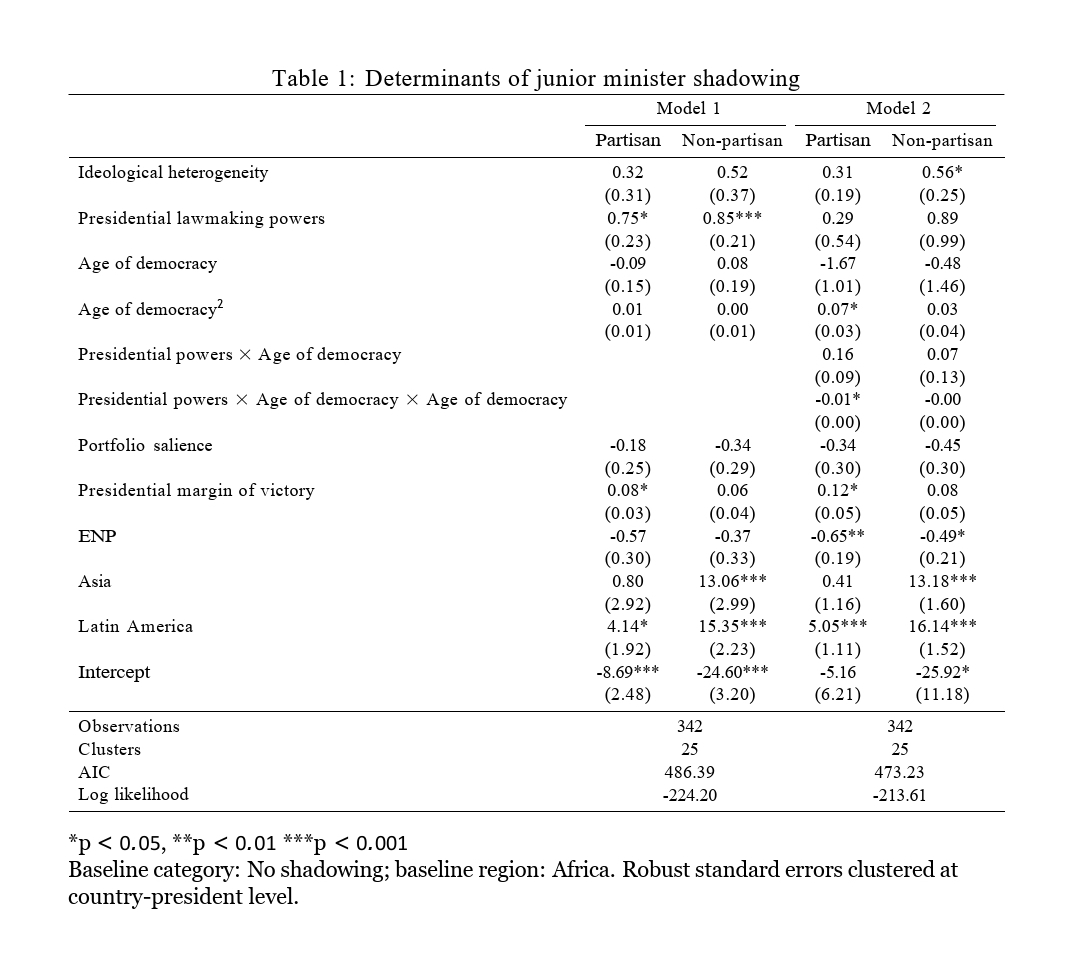
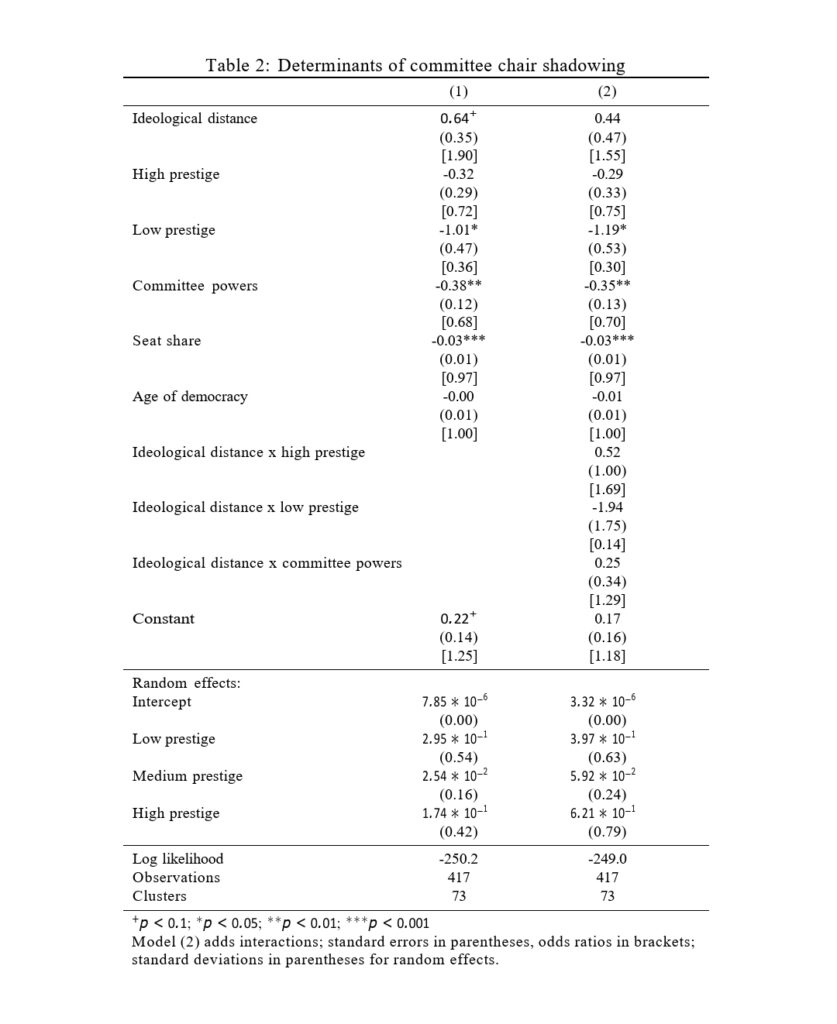
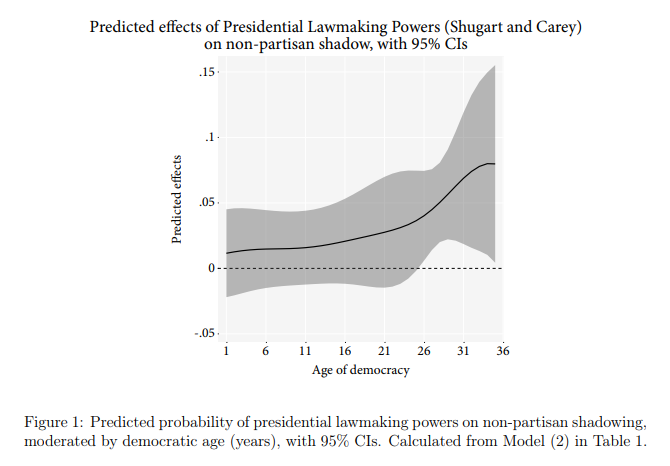
Ideology has a positive effect on both shadowing types in both models (Table 1), though it’s significant only for non-partisan shadowing once interaction terms are added. Table 2 simi-larly shows a positive effect of ideological distance on CC shadowing, reaching significance at the 0.1 level in the baseline model. The evidence for ideology is stronger for CC shadowing, so I confirm H1 for CCs but not JMs. Portfolio salience carries an unexpected negative sign for JM shadowing and never reaches significance, but “Low Prestige” has the expected sign for CC shadowing and is significant at 0.05, confirming H2 for CCs but not JMs. Presi-dential lawmaking powers are positively associated with shadowing, especially non-partisan shadowing (significant at 0.001), confirming H4. The triple interaction between presidential powers and democratic age (squared, to capture non-linearity) reaches significance with a small effect size; Figure 1 supports H5, showing the effect strengthens at higher levels ofdemocratic experience, consistent with a slow-building institutional-learning effect. Com-mittee powers negatively affect CC shadowing (significant at 0.01), supporting H3b, though the small number of countries means this result should be read cautiously. H3b is confirmed with caveats.
As for this research’s contributions: it (1) incorporates countries across three continents for a global view, (2) undertakes an original data-collection effort on sub-ministerial officials, particularly in African and Asian contexts, and (3) privileges coalition parties’ own moti-vations and goals (Alberdingk Thijm 2024b, p. 53). The findings suggest coalition parties in presidential systems care about policy well beyond their assigned portfolios, and work to keep partners aligned with the collectively agreed direction.
The research has the following limitations. Monitoring itself isn’t directly observed; it’s approximated through the partisan configuration of ministers, JMs, and CCs. Regional data access skews the sample toward Latin America, at the expense of Asian and especially African cases. And with relatively few countries, the design isn’t well suited to studying country-level variables. Future work should expand data collection for larger, better-balanced samples, and add qualitative interviews to illuminate how JM and CC allocation and monitoring itself actually play out in practice.