

Leiv Marsteintredet
In March of this year Norway was hit not by one, but by two simultaneous crises. First of all, the COVID-19 pandemic led to the most intrusive measures by any government since World War II and to the almost complete close-down of the country and its economy on March 12. Second, the steep drop in oil-prices has created a double-negative external shock on the Norwegian oil-dependent economy. Although the parliamentary weak three-party coalition was clearly overtaken by events, the strong policy measures have been facilitated by the consensus-tradition in Norwegian politics, and the citizens’ high trust in government. A fast-working parliament secured broad support for the government’s policies facing the COVID-19 pandemic. Further, the strict measures have met high levels of compliance and been regarded as legitimate by a large majority of Norwegians. These factors have likely been key to the (so-far) relative success of the executive’s measures against the Pandemic.
A government overtaken by events
From an executive perspective these crises could not have come at a worse time. The centre-right government coalition led by Prime Minister Erna Solberg of the Conservative Party (Høyre). In January, the government was reduced from a four-party majority coalition to a three-party minority coalition, controlling 61 of 169 seats in Parliament, when the populist right Progress Party (Fremskrittspartiet) left the coalition. The coalition was further weakened by a leadership conflict in the Liberal Party (Venstre), a minor coalition partner, and the abrupt resignation of the party leader, Trine Skei Grande, who resigned as Minister of Education on March 11.
In the days leading up to March 12, the health authorities and the government were clearly overtaken by the rapid development of the COVID-19 pandemic, and underestimated the spread and gravity of the virus. The government’s hesitation and “wait and see” attitude received increasing criticism and the government’s position became untenable when Denmark closed schools on March 11 and implemented broad measures to fight COVID-19, several municipalities in Norway decided to close schools and implement local measures, and universities stopped teaching.
On March 12, however, following recommendations by the Norwegian Directorate of Health, which is granted the authority to implement measures against the pandemic, the government reacted swiftly and broadly, by closing all schools and universities, suspending all sports- and cultural events, implementing quarantine measures for everyone travelling to Norway, in addition to closing many businesses, and recommending home office (for a full list of measures, see here). Newspaper reports show that the government went further than the Norwegian Institute of Public Health recommended, in particular the decision to close the primary schools has later been debated and criticised. Thus, late action might have forced what was perceived by Norwegian health authorities as an overreaction.
In a Scandinavian perspective, however, Norway followed the Danish policies very closely, and both countries implemented broader measures than Sweden, where for instance schools remained open. Although stopping short of implementing a general quarantine, the new, strong measures provided a strong contrast to the policies only hours and days before and took many by surprise. For instance, at my university, the decision to close off the University at 6 pm on March 12 was communicated to students and staff eighteen minutes before shutdown.
Consensus democracy and laws of exception
The Solberg government received widespread support and understanding for most of its restrictive measures on March 12, and subsequent expansions of its measures in the following weeks. The government, however, met harder resistance in the Norwegian parliament (Stortinget) when it came to the economic measures, and quickly discovered it had become a minority coalition. The Norwegian consensus democracy where the parties of right and left agree on broad compromises secured that despite resistance in parliament, the government’s handling of the corona-crisis was not disadvantaged, but likely came out with a broader legitimacy.
Early after lock-down, the Solberg-government sent the first two of several important Corona-related laws to Parliament. The first ‘rescue package’ to deal with the economic effects of the lock-down arrived in Parliament on March 13, and the proposal for temporary ‘law of exception’ was sent to parliament five days later. Both proposals were first rejected and then thoroughly altered by the parliamentary majority. Over a weekend, the first rescue package was salvaged by adding 31 billion NOK (3 billion USD) to the original bill of 2.6 billion NOK. The parliamentary majority of the centre-left parties and the populist right Progress Party argued the government underestimated the negative economic effects of the COVID-19 measures. Parliament overran the government’s proposal, but created a broad consensus proposal that got the government’s support.
The temporary ‘Law of Exception‘, however, also received criticism in several newspapers, by prominent law scholars, and the majority in parliament, and was seen as an unnecessary power grab and by some as an attack on democracy. The Solberg government asked for a 6 months renewable law of exception (after initially having asked for a law with the duration of 12 months) that would allow the government to set aside laws and pass necessary rules and regulations without consulting parliament. Parliament, however, could post-facto overrule the government’s use of the law by a 1/3 vote. The government stated the law was necessary to deal effectively with the crisis and promised not to abuse it. Again, the government had misread the situation. Critics argued the government asked for more powers than what the government enjoyed during World War II. One law professor modestly called the law ‘madness‘, and even though few really feared for the Norwegian democracy, such a carte blanche for the government entailed a potential for abuse the parliamentary majority would not accept. Parliament again acted quickly, reached a broad consensus that included the government parties, and reduced the law’s duration to one month (renewable), provided an ex ante veto for parliament by a 1/3 vote, and restricted when the government could use the powers provided by the law from a general permission to a restricted permission only applicable when due process was not possible. While trust is good, for the sake of individual rights and democracy parliament reasoned control is better. The law of exception was only prolonged once for one more month, and ended on May 27.
Trust and support in times of crisis
The Norwegian consensus democracy is also widely known for relatively high levels of inter-personal trust and trust in the government. Consensus traditions and high levels of trust facilitated quick parliamentary action and has also likely contributed to society’s high level of compliance with the strict COVID-19 measures. A study by the Norwegian Citizens Panel at the University of Bergen shows that the crisis has increased people’s satisfaction with democracy and government, and trust in the politicians and parliament considerably (see graph). Maybe not surprising in times of social distancing and fear of infection of COVID-19, trust in other people is down by 10 points in the same period (from 76% to 66%).
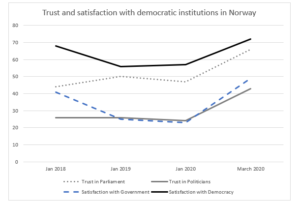
Note: Trust: percentage answering high or very high trust. Satisfaction: percentage answering very satisfied or satisfied.
Source: Ivarsflaten, Elisabeth (2020) “Koronapandemien: Dramatiske konsekvenser i det norske samfunnet”. Unpublished note, April 2. Norwegian Citizen Panel, University of Bergen.
Despite having to compromise and accept being overrun by parliament on several key laws during the crisis, the Prime Minister and her Conservative Party has reaped the largest benefit among voters during the crisis. An average of polls in Norway taken up since the start of the crisis shows that the Conservative Party increased its voting share from 19% to 27% between February and May, where it has remained since. It is also worth noting that the Progress party that left government in January in order to strengthen its (populist) party profile, has dropped from 15% to 10% support in the same period. It seems like polishing the populist profile instead of taking responsibility in government, has not been evaluated positively by the voters, a finding many people may find reassuring.
Leading the country out of the extreme measures
The Solberg-government led us into the most intrusive and restrictive measures Norway has seen since World War II. The government’s policies have been successful so far at least by measuring fatalities. The health system has managed to meet the crisis without being overburdened, and Norway has only 4.7 fatalities per 100,000 (251 deaths in total by July 3), which is less than half of Denmark’s rate of 10.5 with similar policies, and considerably lower than Sweden’s 53.6 fatalities per 100,000. The costs for the economy have been tremendous, however. Partial and full unemployment has skyrocketed from 3.9% in February to 14.6% in early May, figures not seen since World War II. With the gradual easing of restrictions from mid-April, unemployment has been reduced to 9.6%. Although the economy is slowly recovering, the human costs of the economic crisis may be long and hard to overcome even for the strong Norwegian economy lubricated by the oil-financed Pension fund, and we may see a rather abrupt end to the Norwegian economic exceptionalism.
On April 20 Norway started opening up society and businesses in small, but incremental steps. Opening up, Norway has again followed Denmark closely. By early July, the main restrictions are on social distancing (famously called the “one-metre rule”), international travels (where Norway is more restrictive than Denmark and the EU), and events which cannot exceed 200 people. The government is trying to balance demands for quicker opening, especially from the large tourist sector, and keeping control over the spread of the virus. Until now, opening up has been a success, keeping new COVID-19 cases to around 10 per day since May. Despite pressures for a quicker and broader opening, Norwegian high-trust society has supported and complied with the strong COVID-19 measures so far, and seems to continue to support the government’s slow, but gradual opening of the economy and society, thus facilitating policy-making in the next stages of the pandemic.